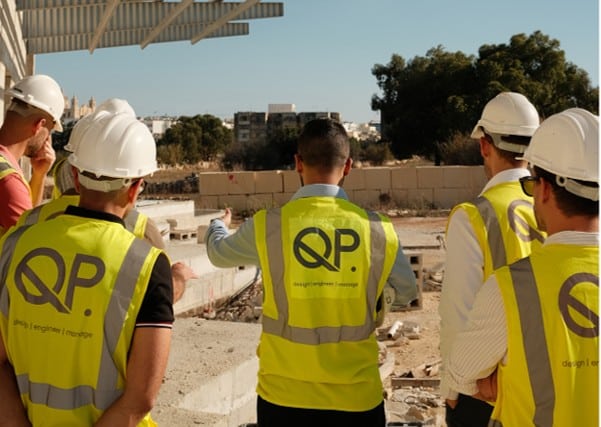
The Increasing Role of Cost Management in Project Loan Monitoring & Bank Engineering
By Sandro Schembri - QP Senior Partner Cost Management
In today's construction and infrastructure environment, lenders are demanding greater commercial oversight, cost certainty, and risk visibility throughout the project lifecycle.
The numbers explain why.
Research by Professor Bent Flyvbjerg, analysed across decades of global infrastructure projects, found that 90% of large projects exceed their original budget, with the average cost overrun sitting at 28% above initial estimates (Digital Construction Week, 2025). For lenders, that is not an abstract statistic — it is the risk profile of every project they finance.
As projects become more complex and market pressures continue to rise, the role of the Cost Management Team within Project Loan Monitoring and Bank Engineering services is evolving significantly. What was once a largely technical, post-contract function has become one of the most commercially important disciplines in development finance.
Why Are Lenders Raising the Bar on Commercial Oversight?
Lenders are no longer content with periodic progress reports and final account sign-offs.
McKinsey research has estimated that global construction inefficiencies cost the industry USD 1.6 trillion annually, with cost overruns typically ranging between 20% and 45% of original project budgets.
Against this backdrop, appetite for independent commercial assurance has grown substantially across financial institutions, private investors, and public development bodies.
In our experience across Malta's project financing landscape, working with the island's main lending banks and entities such as the National Development and Social Fund (NDSF), the shift is consistent and accelerating. Lenders are placing greater emphasis on independent monitoring aligned with recognised international standards — and specifically with RICS professional standards relating to cost management, project monitoring, risk management, and commercial reporting.
What Does Independent Cost Oversight Actually Include?
With increasing scrutiny on development financing, the scope of independent monitoring has expanded well beyond what many lenders were accustomed to a decade ago. Today, comprehensive cost oversight covers seven distinct disciplines, each addressing a specific vulnerability in the development finance process.
Independent cost validation — protects against inflated or unsupported cost submissions from developers.
Budget and contingency assessments — protects against underfunded contingencies that cannot absorb market volatility.
Cashflow and drawdown monitoring — protects against funding releases that are not matched to verified project progress.
Cost-to-complete analysis — protects against lenders losing visibility into remaining financial exposure.
Variation and claims oversight — protects against commercial disputes and scope changes that erode project viability.
Procurement and contractor risk reviews — protects against fragile supply chain arrangements that create downstream cost risk.
Early identification of commercial risks — protects against issues escalating into cost overruns or programme failures undetected.
Together, these disciplines form a coherent commercial assurance framework. The RICS Cost Prediction Professional Standard, reissued in June 2024, establishes the mandatory requirements that RICS professionals must follow when producing cost reports, giving lenders confidence that the outputs they receive are produced to a consistent, internationally recognised standard.
Why Does Independent Oversight Matter for Lenders and Stakeholders?
For lenders, the value of independent cost oversight is straightforward: it reduces uncertainty and supports more informed decision-making. KPMG's Global Construction Survey found that only 25% of construction projects come within 10% of their original budget. Without independent verification at each stage, lenders are effectively relying on developer self-reporting to manage a risk with an industry-wide failure rate of 75%.
Better financial governance — project finances are managed with transparency and accountability at every drawdown stage.
Transparent reporting — all stakeholders receive consistent, independently verified commercial information.
Risk mitigation — commercial risks are identified and managed before they compromise project outcomes.
Improved decision-making — lenders and investors have the data they need to act confidently and responsibly.
Stronger stakeholder confidence — all parties are reassured that projects are being delivered in line with approved budgets and programmes.
Has Cost Management Moved Beyond Its Traditional Role?
The short answer is yes. And the shift has been decisive.
Cost Management today is no longer purely a post-contract or measurement function. It has become a key component of project risk management and financial assurance, active from pre-contract stage through to financial close.
Historically, cost consultants were engaged to measure, value, and settle — activities concentrated at the back end of a project.
In QP's client work across Malta's development finance market, the most effective commercial oversight is now front-loaded, continuous, and advisory in nature. The projects where lenders maintain greatest confidence are invariably those where independent cost oversight begins before construction starts, not after the first drawdown request arrives.
This evolution is reflected at the international standards level. In 2021, RICS and the ICMS Coalition published the International Construction Measurement Standards (ICMS) 3rd edition, which extended the framework to cover the entire project life cycle and introduced a common reporting structure for carbon emissions alongside construction costs.
Lenders operating under modern ESG frameworks increasingly look for monitors whose reporting aligns with ICMS 3.
What Is Driving Demand for This Level of Oversight in Malta?
Malta's construction and development finance market has its own dynamics — a small geography, a concentrated lending market, and a pipeline of projects that range from residential schemes to infrastructure-linked investment.
Across the projects QP monitors on behalf of Malta's main lending banks and the NDSF, three pressures are consistently driving demand for more rigorous independent oversight.
First, project complexity is increasing. Multi-phased developments, mixed-use schemes, and infrastructure projects with multiple funding sources all create commercial structures that require active, ongoing monitoring rather than periodic sign-off.
Second, material cost volatility remains significant. EU construction material prices rose between 25% and 40% between 2021 and 2024, and projects budgeted at today's prices face genuine price risk over 12 to 18-month delivery windows.
Third, lender scrutiny on development financing has increased as interest rate environments have tightened and risk appetites have recalibrated.
What Does This Mean for the Future of Project Loan Monitoring?
As Project Loan Monitoring and Bank Engineering services continue to evolve, commercially driven advisory and proactive cost oversight will play an increasingly central role in successful project delivery.
The transition from reactive cost reporting to forward-looking commercial assurance is well underway — and there is no indication that the direction of travel will reverse.
At QP, this service area has become one of the three main pillars of the Cost Management Team's delivery.
That positioning reflects the growing importance of independent commercial oversight within today's project financing and development environment — and the expectation from lenders and investors that this level of rigour will be a feature of every project they fund, not an exception.
For lenders, investors, and project stakeholders operating in today's environment, the question is no longer whether to engage independent cost oversight. It is whether the oversight they have in place is rigorous, proactive, and genuinely aligned with their commercial interests.
Frequently Asked Questions
What is Project Loan Monitoring and why does it matter to lenders?
Project Loan Monitoring is the independent oversight of a construction or development project on behalf of a lending institution. It provides lenders with verified, real-time commercial assurance — covering cost, programme, and risk — so that funding decisions are based on evidence rather than developer self-reporting. With research by Professor Bent Flyvbjerg showing that 90% of large infrastructure projects exceed their original budget, independent monitoring has become an essential component of responsible development finance.
How does Cost Management differ from traditional quantity surveying in a loan monitoring context?
Traditional quantity surveying focuses primarily on measurement, valuation, and final account settlement — activities concentrated at the back end of a project. In a Project Loan Monitoring context, Cost Management is a continuous, strategic function encompassing budget validation, cashflow monitoring, risk identification, and commercial reporting throughout the project lifecycle. The RICS Cost Prediction Professional Standard (reissued June 2024) and ICMS 3rd edition define the framework within which this wider role is delivered, giving lenders a consistent and internationally credible basis for assessing project financial health.
Why are RICS standards important in Project Loan Monitoring?
RICS (Royal Institution of Chartered Surveyors) professional standards provide a recognised international framework for cost management, project monitoring, and commercial reporting. Lenders rely on independent monitors who operate within these standards because they provide consistency, credibility, and a shared professional basis for assessing project performance. In 2024, RICS reissued its Cost Prediction Professional Standard and the ICMS Coalition published ICMS 3rd edition, both of which set the current baseline for independent cost monitoring in development finance.